
Nvidia Earnings 2026: The AI Boom Is Real. The Fed Made It More Expensive.

The AI boom passed its earnings test. It did not escape the interest-rate test.
Nvidia, Salesforce and CrowdStrike delivered the kind of numbers that turn an AI narrative into current revenue. Then Chair Kevin Warsh reminded markets that 3.7% PCE inflation still gives the Federal Reserve a reason to raise rates. The result was a week in which both the growth story and its financing cost were repriced.
SOURCE-LINKEDweekly market brief
Our working view: AI infrastructure demand remains unusually strong, but the market is becoming more selective. Companies converting AI investment into current revenue can still win. Companies asking investors to wait for distant revenue are increasingly exposed to higher yields.
AssetScreener Research · August 30, 2026
Frozen market snapshot through the U.S. close on August 28, 2026. Company figures use primary earnings releases; cross-asset moves use source-linked market reporting. This is market research, not personalised investment advice.
The original thesis is intact: AI demand strengthened while the rate constraint became harder.
Before the U.S. market open on September 2, Dell raised its annual revenue and profit forecasts after reporting record quarterly revenue of $47 billion. Reuters also cited a record $60 billion of AI-server orders and a $95 billion backlog. That broadens the evidence that the AI infrastructure cycle extends beyond Nvidia’s own results.
The macro side moved in the opposite direction. Brent crude traded near $95 and the U.S. 10-year Treasury yield reached about 4.81% as renewed U.S.–Iran conflict increased inflation concerns. Broadcom’s results after the September 2 close and the September 4 U.S. payroll report are the next major tests.
Status assessment: thesis intact. This update adds a September 2 market snapshot without rewriting the original August 28 evidence boundary.
What was actually hot this week?
Verified AI monetisation. Nvidia doubled revenue year over year. Salesforce showed triple-digit growth in AI-related recurring revenue. CrowdStrike delivered record net new annual recurring revenue. Semiconductors, enterprise software and cybersecurity attracted the capital — but only where the numbers were already visible.
The macro counterweight was just as clear. Sticky PCE inflation and a hawkish Jackson Hole speech pushed short-term Treasury yields and the dollar higher on Friday, hitting smaller companies, technology, gold and Bitcoin.
- Nvidia Q2 revenue
- $96.2B+106% year over year
- Data Center
- $89.0B+117% year over year
- Core PCE
- 3.3%July, year over year
- 2-year yield
- 4.36%+12.8 bp on Friday
Semiconductors, AI software and cybersecurity — especially companies showing current revenue, recurring revenue and cash-flow conversion.
Inflation is easing too slowly for the Fed’s comfort. Higher front-end yields raise the hurdle rate for every long-duration growth story.
Thursday said “the demand is real.” Friday said “the discount rate is real too.”
I keep coming back to the 24 hours between Thursday’s close and Friday’s Jackson Hole speech. It was the cleanest explanation of the market we have seen all month.
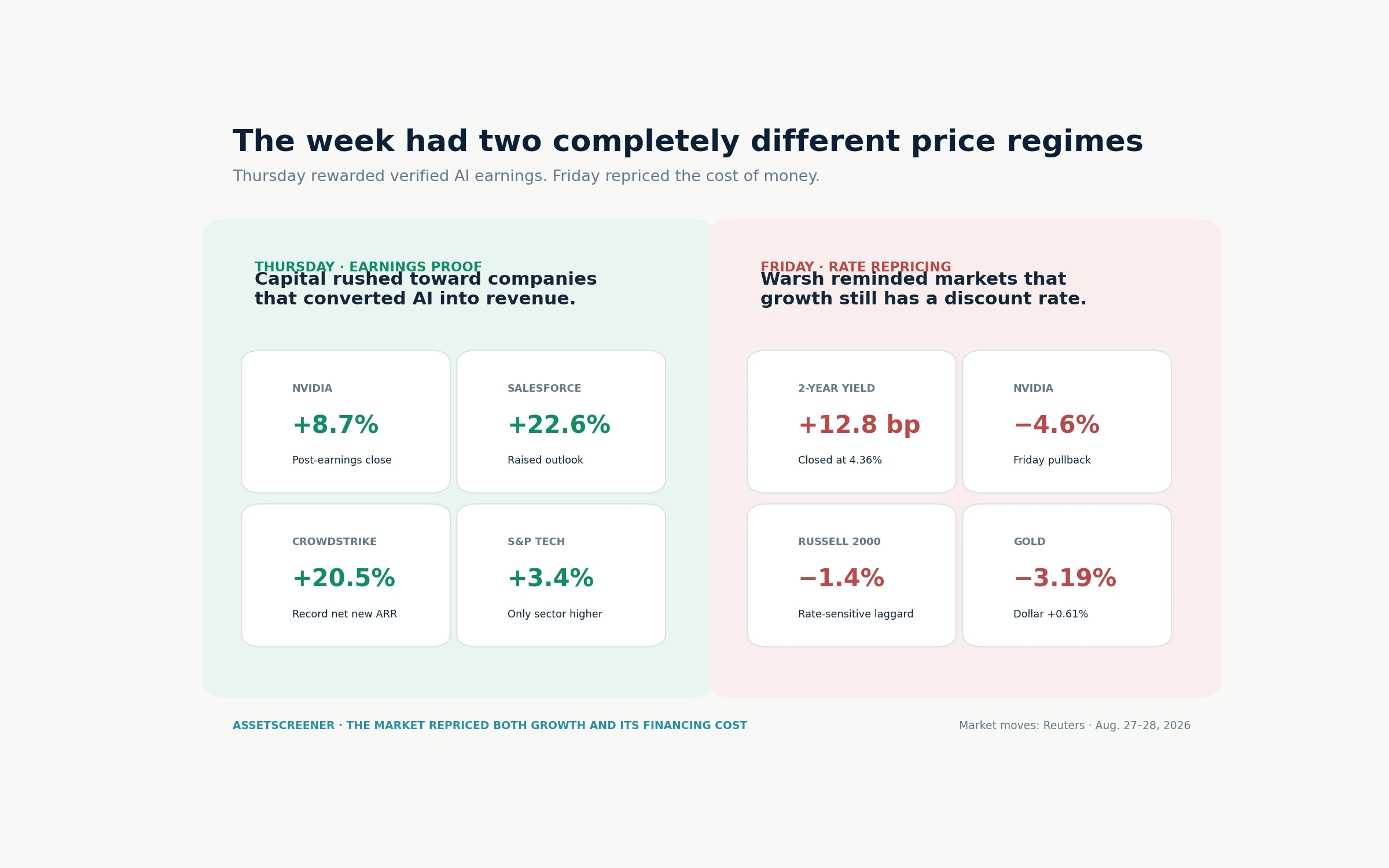
On Thursday, Nvidia’s outlook pulled capital back into the AI complex. Nvidia finished up 8.7%, the S&P 500 technology sector gained 3.4%, and technology was the only one of the index’s eleven major sectors to finish higher. Salesforce jumped 22.6%. CrowdStrike rose 20.5%. The Nasdaq gained 1.57%.
Then Friday arrived. Warsh reiterated that the Fed’s 2% inflation target is fixed, and traders lifted the implied probability of a September rate increase to 55.7% from 35.4% the previous day. The two-year Treasury yield rose almost 13 basis points. Nvidia gave back 4.6%. The rate-sensitive Russell 2000 fell 1.4%.
Same market. Two truths. The AI earnings cycle is real, and money is still expensive.
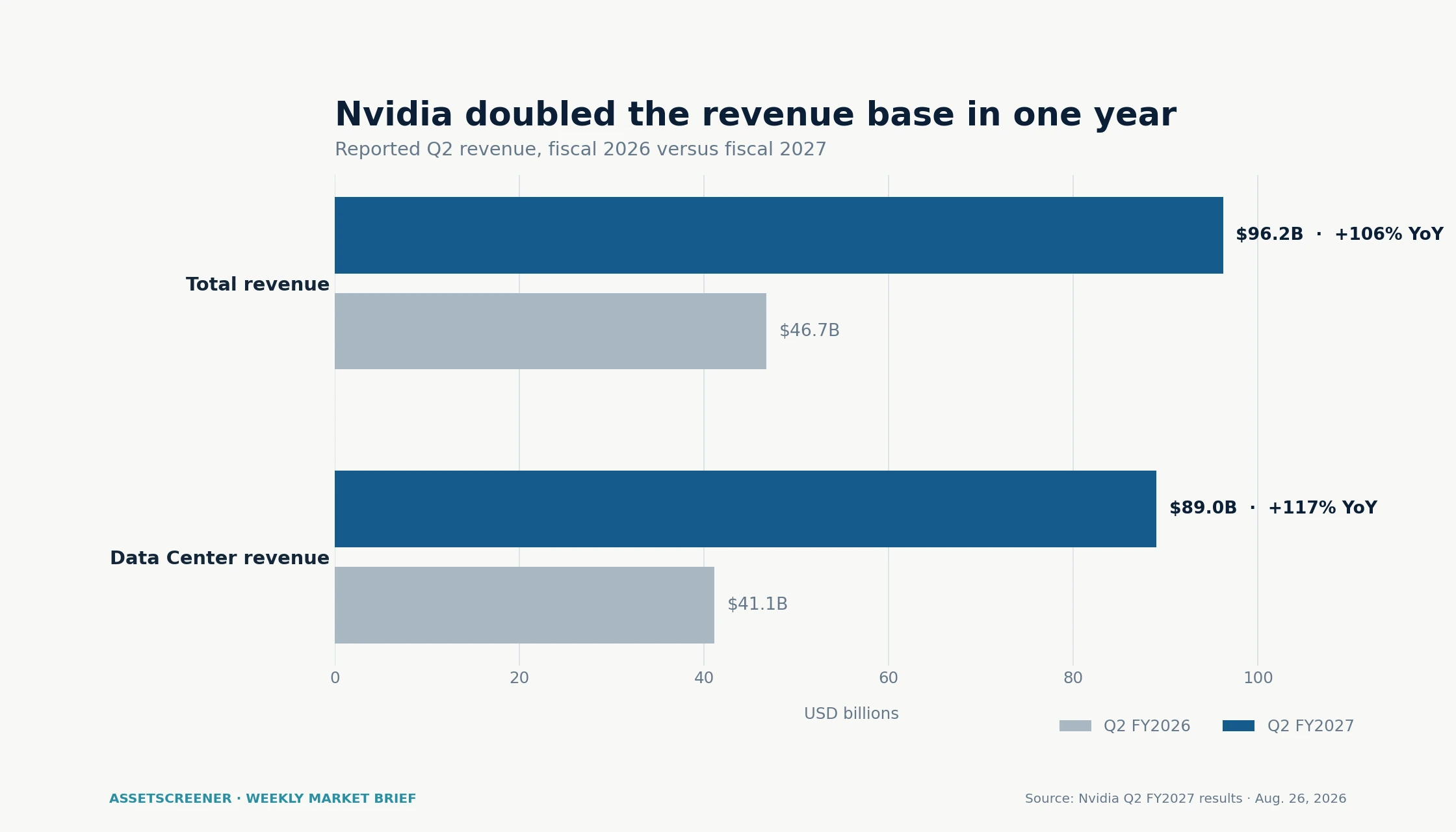
Nvidia did not merely clear the bar. It moved the bar again.
Nvidia reported second-quarter fiscal 2027 revenue of $96.2 billion, up 18% sequentially and 106% from a year earlier. Data Center revenue reached $89.0 billion, up 117% year over year. Operating income rose 124% to $63.7 billion.
The forward numbers were the part the market had been waiting for. Nvidia guided third-quarter revenue to $108 billion, plus or minus 2%. On the earnings call, management said it expected roughly 70% revenue growth in fiscal 2028 — far beyond the visibility investors normally receive from the company.
This matters beyond one stock. Nvidia is the most direct public read-through on the physical AI buildout: accelerators, networking, memory, power, cooling, cloud capacity and data-center construction. If its data-center revenue had slowed sharply, the entire capital-spending chain would have been questioned. It did the opposite.
There is still a detail worth respecting: Nvidia expects gross margin to ease from 75% in Q2 to approximately 74% in Q3. One point is not a collapse. But when expectations are this elevated, the market will watch whether supply constraints, memory costs and system complexity begin consuming more of the growth.
The more important signal was not only chips. AI software finally brought receipts.
A hardware boom can be enormous and still become vulnerable if customers cannot turn the compute into useful products. This week, software and cybersecurity supplied evidence that the monetisation layer is beginning to catch up.
Salesforce said Agentforce and Data 360 annual recurring revenue reached nearly $3.9 billion, up more than 210% year over year. Agentforce ARR alone exceeded $1.5 billion, up more than 240%. The company raised its full-year revenue and profit outlook, and the stock surged 22.6% on Thursday.
CrowdStrike reported revenue of $1.47 billion, up 26%, with annual recurring revenue of $5.84 billion, up 25%. Record net new ARR reached $332.8 million. Management raised its fiscal-year net new ARR growth outlook to 34% at the midpoint.
This is the part of the week I find most constructive. Chips proved that infrastructure spending is still accelerating. Salesforce and CrowdStrike showed that AI-related software, workflow and security demand can produce measurable recurring revenue too.
Nvidia’s report supported memory, networking, foundry, optics and AI-cloud names — the physical picks-and-shovels layer.
Salesforce showed that agentic software is moving from demos into recurring revenue and higher guidance.
CrowdStrike showed that more AI adoption can expand the security bill rather than simply cannibalise existing software budgets.
Marvell delivered growth — and the market still said “not soon enough.”
Marvell raised its fiscal 2027 and 2028 revenue forecasts, supported by demand for custom AI chips. Yet the stock fell 10.3% on Friday as investors focused on how long it could take for the Google agreement to contribute materially.
That reaction is more useful than it first appears. It says the market is no longer rewarding every company that can attach “AI” to a distant forecast. At higher interest rates, revenue expected in fiscal 2029 is worth less today than revenue already visible in the next quarter.
In plain English: the theme remains hot, but the burden of proof has risen. Current backlog, conversion speed, gross margin, cash generation and customer concentration now matter more than the headline size of a future deal.
Inflation is cooling — just not fast enough to make the Fed comfortable.
The Bureau of Economic Analysis reported that July headline PCE inflation was 3.7% year over year, unchanged from June. Core PCE was 3.3%. Both indexes rose 0.2% month over month.
The composition was also revealing. Real consumer spending was essentially flat in July. Spending on services increased while spending on goods fell. That is not a collapse in demand, but it is hardly the clean disinflationary growth mix that would force the Fed to ease.
Warsh used Jackson Hole to remove any ambiguity around the target. He described 2% PCE inflation as a firm, fixed objective and said short-term interest rates remain the predominant tool. Markets heard a central bank willing to hike again if inflation fails to move convincingly lower.
The core macro conflict is simple: corporate earnings are strong enough to support equities, but inflation is still high enough to keep the discount rate hostile. The winner is not automatically “stocks” or “bonds”; it is whichever companies can grow faster than their cost of capital rises.
AssetScreener interpretation of BEA data and the August 28 Fed speech
The Friday reaction showed exactly which assets fear higher rates.
The two-year Treasury yield rose 12.8 basis points to 4.36%, far more than the move in longer maturities. That is the bond market pricing the Fed, not merely long-run growth. The ten-year yield rose 5.6 basis points to 4.728%.
The dollar index gained 0.61%, its strongest daily rise in roughly two and a half months. Gold fell 3.19%. Bitcoin fell 3.34%. The Russell 2000 underperformed with a 1.4% decline. Those moves share a common sensitivity: a stronger dollar and a higher short-term risk-free rate.
Yet the week as a whole still finished positive: the S&P 500 gained 0.49%, the Nasdaq 0.85% and the Dow 0.53%. That is why calling the week simply bullish or bearish misses the point. Earnings won the week. Rates controlled the final word.
Breadth was also weaker than the index closes suggested on Friday. Decliners outnumbered advancers by 1.77 to 1 on the NYSE and 2.19 to 1 on Nasdaq. Nasdaq recorded 120 new lows against 51 new highs. The headline indexes remain near records, but participation is not uniformly healthy.
Where the week concentrated attention
This is a relevance map, not a buy list.
AI accelerators and systems
Nvidia remains the cleanest demand signal. Watch Rubin ramp, Q3 revenue delivery and the one-point gross-margin step-down.
Memory, networking and optics
Micron, SK Hynix, Broadcom, Marvell and the optical supply chain sit directly behind the compute buildout. The market will distinguish immediate bottleneck revenue from long-dated promises.
Enterprise agents and data
Salesforce’s ARR data moved the discussion from AI experimentation toward monetised workflows.
Cybersecurity
CrowdStrike’s record net new ARR supports the idea that agentic adoption expands the security surface and the addressable budget.
Rate-sensitive small caps
The Russell 2000 remains a useful stress gauge. Smaller companies feel refinancing costs sooner and have less megacap earnings insulation.
Three ways the AI-versus-rates conflict resolves
These are monitoring frameworks, not forecasts.
Earnings outrun the discount rate
Broadcom and the remaining technology reporters confirm Nvidia’s visibility, AI revenue broadens through software and security, and upcoming labour data soften without collapsing.
- Confirmation
- Improving market breadth; stable or lower two-year yield; continued upward earnings revisions.
- Invalidation
- AI revenue guidance weakens while yields keep climbing.
Strong fundamentals, violent rotation
AI leaders keep delivering, but inflation leaves rates high. Capital rotates rapidly between profitable AI winners, defensives and short-duration assets.
- Confirmation
- Indexes hold near highs while breadth stays uneven and earnings-day dispersion remains extreme.
- Invalidation
- Broad participation develops in either direction.
The rate hurdle finally wins
Payrolls and inflation remain firm, the Fed hikes, front-end yields rise further and long-duration valuations compress even as revenue grows.
- Confirmation
- Two-year yield breaks higher; Russell 2000 and Nasdaq breadth deteriorate; AI leaders fail to hold good earnings gaps.
- Invalidation
- Disinflation resumes and earnings revisions remain positive.
The strongest objection to this framework
The best counterargument is that AI earnings power is now so strong that modestly higher rates may not matter much. Nvidia’s operating income more than doubled. S&P 500 second-quarter earnings were on pace to rise 34.5% year over year on an adjusted basis, according to LSEG data cited by Reuters. If earnings keep compounding at that speed, valuation compression can be absorbed.
There is also a benign interpretation of the Fed. A rate hike driven by resilient demand is less dangerous than a hike delivered into collapsing profits. The market could tolerate tighter policy if nominal revenue growth, productivity and cash generation remain exceptional.
What would change our caution? Broader participation, stable credit, lower inflation without a profit recession, and evidence that AI capex produces cash flows across more than a handful of companies.
What we are watching now
Broadcom earnings
The next major test of custom silicon, networking and AI-infrastructure visibility arrives in the coming week.
August payrolls
Consensus expected roughly 58,000 jobs after July’s 23,000 decline. A strong surprise would reinforce the September rate-hike case; another weak print would challenge it.
The two-year Treasury yield
At 4.36%, it is the cleanest live measure of how aggressively markets price the Fed path.
AI earnings-gap retention
Good reports matter most when stocks keep the gap after the first burst of enthusiasm. Nvidia’s Friday reversal makes that test immediate.
Market breadth
If the S&P 500 stays near highs while Nasdaq new lows expand, the index can look healthier than the average stock feels.
Plain-English interpretation
Why did Nvidia stock rise after its earnings?
Nvidia reported $96.2 billion in quarterly revenue, up 106% year over year, and guided the following quarter to approximately $108 billion. Management also gave unusually strong longer-term visibility, supporting the view that AI infrastructure spending remains intense.
Which stock-market sectors were hottest this week?
Semiconductors, enterprise AI software and cybersecurity drew the most attention. Nvidia supported the chip complex, while Salesforce and CrowdStrike showed strong recurring-revenue growth tied to AI adoption.
Why did technology stocks fall after positive AI earnings?
Fed Chair Kevin Warsh reinforced the 2% inflation target and the role of interest rates in achieving it. Markets increased the probability of a September rate hike, lifting Treasury yields and reducing the present value of long-duration growth cash flows.
What did July PCE inflation show?
Headline PCE inflation was 3.7% year over year and core PCE was 3.3%. Both rose 0.2% from June. Inflation was below its May pace but still well above the Fed’s 2% objective.
Is the AI trade overvalued?
There is no single answer for the whole theme. This week showed increasing selectivity: companies with current revenue and strong guidance were rewarded, while delayed monetisation was punished. Valuation depends on growth durability, margins, financing costs and how quickly future demand becomes cash flow.
What could move the market next?
Broadcom earnings, the August U.S. payroll report, the two-year Treasury yield and whether Nvidia, Salesforce and CrowdStrike retain their post-earnings gains are the clearest near-term tests.
Open the evidence behind this edition
Primary company and government sources are used for reported figures. Reuters is used for live market moves and consensus expectations.
- Nvidia — Q2 fiscal 2027 financial results
- Nvidia — Q2 fiscal 2027 earnings-call transcript
- Salesforce — Q2 fiscal 2027 results
- CrowdStrike — Q2 fiscal 2027 results
- U.S. Bureau of Economic Analysis — July 2026 PCE inflation and spending
- Federal Reserve — Chair Kevin Warsh at Jackson Hole
- Reuters — Nvidia-led technology rally
- Reuters — Friday close, weekly returns and breadth
- Reuters — Cross-asset reaction to the Fed speech
- Reuters — Marvell forecasts and timing concerns
- Reuters — Payrolls and Broadcom next-week setup
- AssetScreener methodology
- AssetScreener data sources
- Reuters — Dell AI-server demand and raised outlook
- Reuters — September 2 oil, bonds and global markets update
How this brief was produced
This edition compares primary company earnings with official U.S. inflation data, the Federal Reserve chair’s published Jackson Hole remarks and source-linked cross-asset market moves. Reported facts are separated from AssetScreener interpretation. The strongest counter-case and explicit invalidation conditions are shown rather than hidden.
AssetScreener Research asks a simple question: something changed — who did it affect, did prices notice, and what evidence would prove the thesis wrong?
Publication details and review trail
The page keeps its publication date, source register, definitions, original calculations and primary-source links visible so readers can verify the context.
- Suggested citation
- AssetScreener Research (2026-08-30). Nvidia Earnings 2026: The AI Boom Is Real. The Fed Made It More Expensive. https://www.assetscreener.com/research/nvidia-earnings-ai-stocks-fed-inflation-2026/
- Research scope
- Nvidia earnings 2026, AI stocks, semiconductor stocks, Salesforce, CrowdStrike, PCE inflation, Federal Reserve, Jackson Hole, Treasury yields, U.S. dollar and cross-asset market analysis.