
The Fed Paused. The Fuel Squeeze Didn’t.
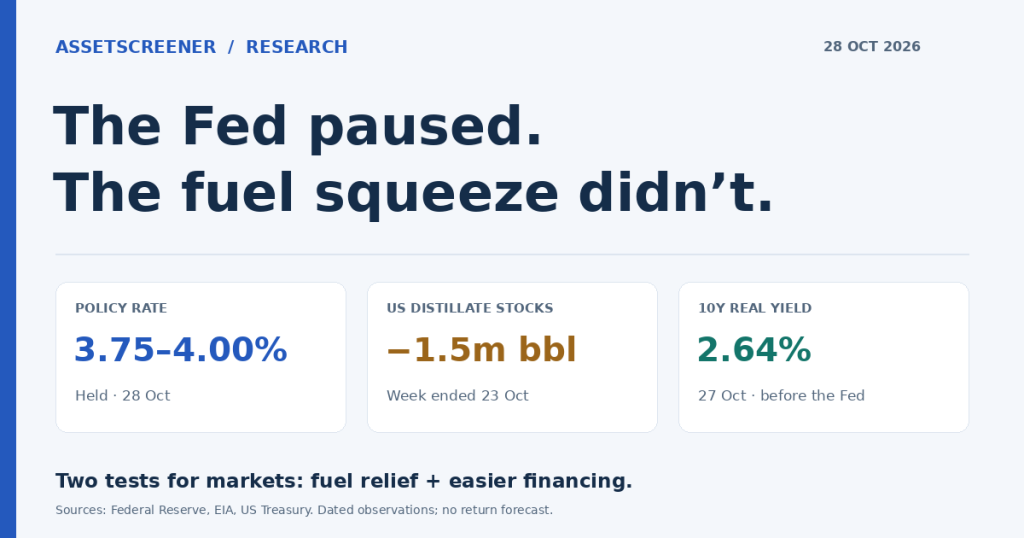
An unchanged Fed rate does not settle the market outlook. The more useful test is whether fuel costs and financing conditions improve together.
Real yields have eased. Fuel relief is uneven. The Fed held its policy rate today. Before that decision, real Treasury yields had already fallen. Meanwhile, U.S. diesel prices rose and distillate inventories shrank, even as gasoline supply improved.
Our view: a broader, more durable recovery in risk appetite needs fuel relief alongside easier financing, with growth holding up. A pause in rate increases alone does not establish that combination.
Research cutoff: 28 October 2026, 19:50 UTC. This is a dated research snapshot, not a market-close report. Policy: 28 October. Inventories: week ended 23 October. Retail fuel: 26 October. Treasury yields: through 27 October. The dates are deliberately kept separate.
The Fed held. Two voters wanted another increase.
The October 28 FOMC decision kept the federal funds target at 3.75–4.00%, with a 10–2 vote. Both dissenters preferred a quarter-point increase. September’s quarter-point increase had been unanimous. Today’s statement also described economic activity as expanding at a “strong” pace, replacing “solid” in September. [1] [2]
Our interpretation: the committee paused the action without declaring victory over inflation. The decision itself supplies neither a cut nor a timetable for one. Equally, stronger activity is counterevidence to a claim that the Fed already sees an economy in recession.
That updates the question in our October 22 oil analysis. The relevant market risk does not require a new oil record: expensive fuel can squeeze cash flows while financing costs determine how generously investors value those cash flows.
Fuel availability and bond-market relief are diverging.
The latest U.S. inventory report is mixed. Commercial crude and distillates drew; gasoline built. Distillates were about 10% below their five-year seasonal average, compared with roughly 4% for commercial crude and 2% for gasoline. A distillate draw matters for freight and heating fuels, but it is not evidence that every petroleum product is getting scarcer. [3]
Gasoline rebuilt. Distillates drew again.
Selected U.S. stocks · week ended 23 October 2026. Left of zero: draw. Right: build.
Our previous article acknowledged a distillate build for the week ended October 16. That relief did not continue in the following week. We keep both observations in the record: one draw does not establish an uninterrupted shortage, just as one build did not end the squeeze.
The diesel bill rose as gasoline eased.
U.S. average retail prices · 19–26 October 2026 · taxes included.
Our reading: a lower gasoline price provides some consumer relief while diesel still pressures freight and other users. This split is more informative than treating a single crude quote as the energy bill for the entire economy.
The bond evidence points the other way. From October 1 to October 27, the ten-year nominal Treasury par yield fell 25 basis points to 4.99%; the real par yield fell 24 basis points to 2.64%. A basis point is 0.01 percentage point. All of these observations precede today’s decision. [5] [6]
Bond yields eased before today’s pause.
All 18 October trading-day observations available through 27 October. Two panels; separate yield levels.
The near-matching declines suggest that this comparison cannot be described simply as a large fall in inflation compensation. We do not estimate a formal breakeven from par-yield subtraction. Nor do lower real yields by themselves prove easier funding for every borrower: credit risk and lending standards can offset the benefit.
Two separate tests explain the market better than one headline.
Can the fuel bill normalize?
Better deliveries and product availability can reduce costs for consumers and businesses. Watch actual fuel prices and inventory rebuilding, alongside crude. A price drop caused by collapsing demand carries a different message.
Can financing ease while growth holds?
Lower real yields can support valuations. A durable improvement is more persuasive when credit conditions and business activity also hold up. Falling government yields during a growth scare can coexist with rising corporate borrowing costs.
These are AssetScreener’s explanatory tests, not a backtested trading indicator. Fuel inflation and real yields do not explain every return; earnings, currencies, positioning, policy and company-specific news also matter.
What this means for stocks, bonds, gold and Bitcoin.
Relief needs to reach margins.
Lower real yields can help valuations; persistent fuel costs can still hurt profits. Energy producers, freight operators and consumers have different exposures.
Watch: earnings revisions, pricing power and whether participation broadens beyond a few leaders. Index strength alone cannot establish that the squeeze is over.
A Treasury rally can mean two things.
Disinflation with resilient growth can support bonds and risk appetite together. A growth scare can also lift Treasuries while hurting riskier corporate debt.
Watch: real yields alongside credit conditions. A government yield is not a company’s all-in financing rate.
A tailwind is not a guarantee.
Lower real yields can reduce the opportunity cost of owning gold. The dollar, official-sector demand and investor flows can reinforce or offset that channel.
Watch: whether gold holds up as yields change. Our gold-versus-Bitcoin study explains why an inflation-hedge label is insufficient.
Separate the thesis from the funding cycle.
A long-term scarcity argument does not remove short-term exposure to liquidity, leverage or risk appetite. A Fed hold alone supplies no Bitcoin buy signal.
Watch: sustained price strength alongside funding and spot demand. This article does not assess current ETF flows or leverage, and it publishes no private BitcoinReversal signal.
These are conditional mechanisms, not forecasts of relative performance. Our ten-year Treasury yield analysis develops the financing channel in more detail.
Three paths—and what would make us reconsider.
Our working interpretation is an uneven adjustment: real yields have declined from early October, but the physical fuel squeeze remains unresolved. The following tests carry no calibrated probabilities or price targets.
Fuel costs ease without a growth break.
Confirmation: repeated distillate rebuilding from the 102.8-million-barrel starting point, lower diesel prices from $6.352 per gallon, and real yields that remain below early-October levels while activity holds up.
What weakens it: renewed fuel draws or higher diesel prices despite the financing improvement. Gasoline relief alone is incomplete confirmation.
Energy costs resist the bond-market relief.
Confirmation: distillate buffers keep eroding and diesel stays costly; renewed real-yield increases would add a second pressure on valuations.
What weakens it: sustained product-stock rebuilding and falling delivered fuel costs. A higher crude headline without those physical checks is weaker evidence.
Cheaper oil arrives for an unwelcome reason.
Confirmation: energy prices and government yields fall while business activity, earnings expectations or credit conditions deteriorate.
What weakens it: resilient real spending and activity alongside easing costs. Today’s stronger Fed activity assessment is a reason not to assume this path has already arrived.
The next scheduled test is close: BEA lists both the advance estimate of third-quarter GDP and September Personal Income and Outlays for October 29 at 8:30 a.m. EDT (12:30 UTC). Neither release was available at this article’s cutoff. [7] The Fed’s 2% inflation objective refers to the PCE price index. [8]
One quarterly GDP number will not settle the whole framework. The useful question is whether the spending and inflation detail supports resilient demand with easing pressure, or forces a less comfortable interpretation.
The policy pause is real. Broad relief still needs evidence. Lower real yields are a constructive counterweight to the energy squeeze, not a reason to ignore it. Watch the fuel bill and financing together—and check why each is moving.
Three questions behind the headline.
Does a Fed pause mean monetary easing?
Not by itself. The target range is unchanged. Market yields can ease independently, as they did before this meeting, but broader financial conditions also include credit, currencies and lending.
Why focus on diesel when gasoline got cheaper?
They serve different uses. The latest inventory and pump-price evidence shows a split. Gasoline relief helps some consumers while diesel costs can still pressure freight and business margins.
Do lower real yields guarantee gains in gold or Bitcoin?
No. They can be one supportive input. Currency moves, investment demand, liquidity, positioning and asset-specific factors can overwhelm it. We make no return forecast from the yield change.
Sources, chart data and limits.
Observation record: FOMC statements dated September 16 and October 28; EIA week ended October 23, released October 28; retail fuel observations dated October 26, released October 27; all available October Treasury trading-day observations through October 27. Data pages can roll forward or be revised.
Calculations: stock changes use EIA’s reported one-decimal figures. Retail change in cents = (new dollars per gallon − prior dollars per gallon) × 100. Yield change in basis points = (new percentage yield − prior percentage yield) × 100. Nominal and real yields are par-curve measures; their difference is not presented as a formal zero-coupon breakeven or a pure inflation forecast.
Scope: U.S. fuel evidence is not a complete global oil balance. No synchronized asset-return comparison, causal regression, recession probability, strategy backtest or current credit-spread assessment was conducted. The pre-meeting yield chart cannot identify the market response to the October 28 statement. Press-conference commentary and the October 29 releases are outside this snapshot.
Preparation: AI-assisted research, writing and charts, checked against primary sources for dates, definitions, arithmetic and counterevidence. Editorial responsibility: Simon Dahlgren. This is not an independent external analyst review. See our methodology, editorial policy and corrections contact.
View the exact chart values and observation dates
| U.S. measure | Earlier | Later | Change |
|---|---|---|---|
| Commercial crude, ex-SPR · m bbl | 16 Oct: 412.5 | 23 Oct: 410.6 | −1.9 |
| Gasoline stocks · m bbl | 16 Oct: 205.3 | 23 Oct: 209.2 | +3.9 |
| Distillate stocks · m bbl | 16 Oct: 104.3 | 23 Oct: 102.8 | −1.5 |
| Regular gasoline · $/gal | 19 Oct: 4.284 | 26 Oct: 4.269 | −1.5¢ |
| On-highway diesel · $/gal | 19 Oct: 6.276 | 26 Oct: 6.352 | +7.6¢ |
| October 2026 | 10Y nominal · % | 10Y real · % |
|---|---|---|
| 1 Oct | 5.24 | 2.88 |
| 2 Oct | 5.28 | 2.92 |
| 5 Oct | 5.31 | 2.95 |
| 6 Oct | 5.27 | 2.91 |
| 7 Oct | 5.28 | 2.92 |
| 8 Oct | 5.22 | 2.87 |
| 9 Oct | 5.24 | 2.91 |
| 13 Oct | 5.21 | 2.88 |
| 14 Oct | 5.19 | 2.84 |
| 15 Oct | 5.10 | 2.78 |
| 16 Oct | 5.09 | 2.74 |
| 19 Oct | 5.15 | 2.80 |
| 20 Oct | 5.12 | 2.77 |
| 21 Oct | 5.13 | 2.76 |
| 22 Oct | 4.96 | 2.64 |
| 23 Oct | 5.00 | 2.66 |
| 26 Oct | 5.00 | 2.66 |
| 27 Oct | 4.99 | 2.64 |
- Federal Reserve: October 28 FOMC statement. Decision, vote, dissent preferences and activity assessment. Released at 2 p.m. EDT.
- Federal Reserve: September 16 FOMC statement. Prior increase, unanimous vote and earlier activity description.
- EIA: Weekly Petroleum Status Report summary. Week ended October 23: inventory changes and seasonal comparisons. Companion crude-stock table. These URLs roll forward.
- EIA: Gasoline and Diesel Fuel Update. October 27 release, observations dated October 19 and 26; U.S. average retail prices including taxes. URL rolls forward.
- U.S. Treasury: daily nominal par yield curve, 2026. Ten-year series through October 27. The complete October inputs are reproduced above.
- U.S. Treasury: daily real par yield curve, 2026. Ten-year inflation-indexed series through October 27.
- BEA release schedule. GDP and Personal Income and Outlays scheduled for October 29; timetable checked October 28.
- Federal Reserve: the 2% inflation objective. The target’s PCE definition.
Reuse & citation: Original AssetScreener charts may be reused with attribution and a link to this analysis. Underlying figures retain the source attribution above. Suggested citation: AssetScreener Research (28 October 2026), “The Fed Paused. The Fuel Squeeze Didn’t.”
Independent market research and education; not personalized investment advice. Conditional scenarios do not guarantee investment outcomes.